The fountains, meeting points of water sources with citizens, are an important part of Ottoman social and architectural history. The oldest structures of water date back to Roman time. After the conquest of the city, the rundown water systems such as aqueducts were repaired and new systems, throughout the later eras as well, were built to supply water to the citizens. Fountains were one of the sources of this water supply. Turks have always placed importance on water since a long time ago and had some practices and beliefs on water. however, it became more crucial after the acception of Islam by Turks as water has an essential role in Islam, especially in terms of cleaniness.
It is considered a great charity to provide water to people which is the reason most of the fountains were built in Ottoman things which will help a great deal of people are considered a good deed which will help the person acquire good deeds even after he passes away. When it is asked to Prophet Muhammad (pbuh) what the best charity is, he said “Providing drinking water”. Especially Sultans, Sultans’ mothers, wives and daughters endowed money for the construction of fountains mostly out of such religious intentions. The fountains decorated both the outdoors, especially after the 16th century, and indoors of the houses. They were the indicators of style, change and novelty in the architecture of their time. It is reported that there were still 1,600 Ottoman fountains in Istanbul at the start of the 20th century.
Visitors can see different types of foundation while strolling around the city. Wall fountains are mostly fountains whose tanks are connected to the wall and built with dimension stone. They became popular especially after the 15th century until the 20th century. Shadirvan fountains look like a stone stake which has pipes in its basin. They can not be seen in Istanbul today even though it is thought to be common in the old times. Freestanding fountains were built in the squares and across the piers. They were to be seen after the 18th century with the effect of westernization. Another type of foundation is the column fountain. This type of fountain was seen after the 18th century. It was made by craving a waterway inside the marble columns and putting a pipe and tap on it.
Here are some important and famous fountains in İstanbul;
Fountain of Davut Paşa
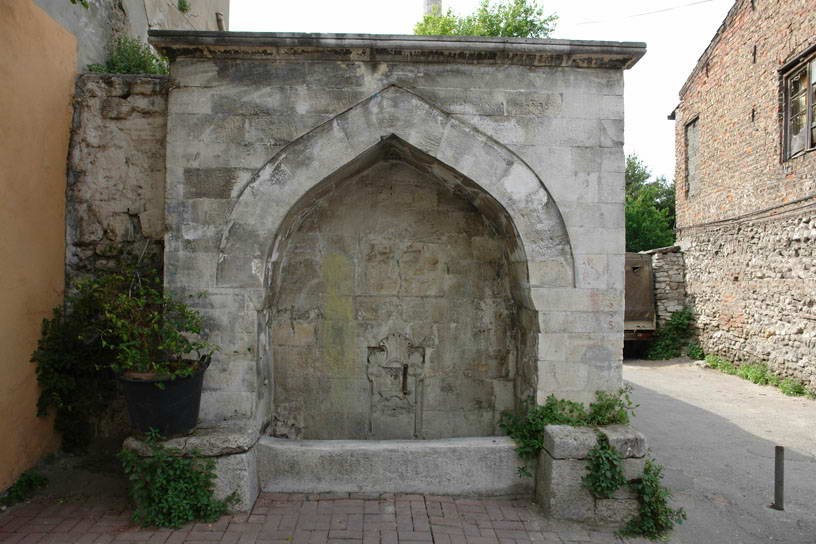
It is a wall type of fountain. Davut Paşa Fountain is considered one of the oldest fountains in Istanbul. It was built in 1485 with the endorsement of Davut Paşa who was a vizier of Fatih Sultan Mehmet, conqueror of Istanbul.
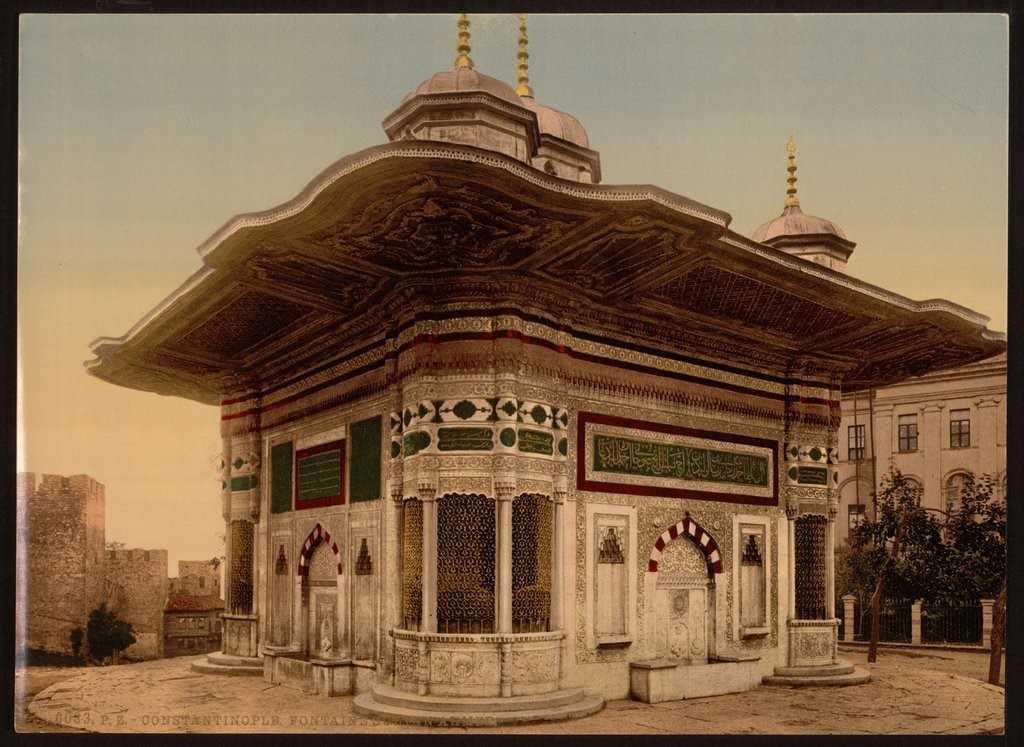
The Fountain of Ahmed III is located between the entrance of Topkapı palace and Hagia Sophia Mosque which are in Fatih district. The fountain is important because the transition of architectural style to a more western fashion can be seen clearly on the architecture of this fountain. It was built with the endorsement of Sultan Ahmet III in 1728 during the “Tulip period” in which European influence started to manifest itself in art, architecture and so on. It was built as a square block with five small domes on it. In its square plan, it has three networked fountains on the four corners, each of which protrudes as half-round protrusions and There is a fountain in the middle of each facade. All surfaces have been decorated without leaving any empty spaces, and although some of these decorations belong to Turkish decorative art, motifs taken from Western European art are also seen among them.
Gülhane Park Fountain
If visitors pay attention, they will see a wall fountain at the entrance of Gülhane park. The fountain was endorsed by Sultan Ahmed I. and built in 1605 to be rebuilt in 1889 by Abdülhamit II. Calligraphy writings from both constructions still exist on it.
German Fountain
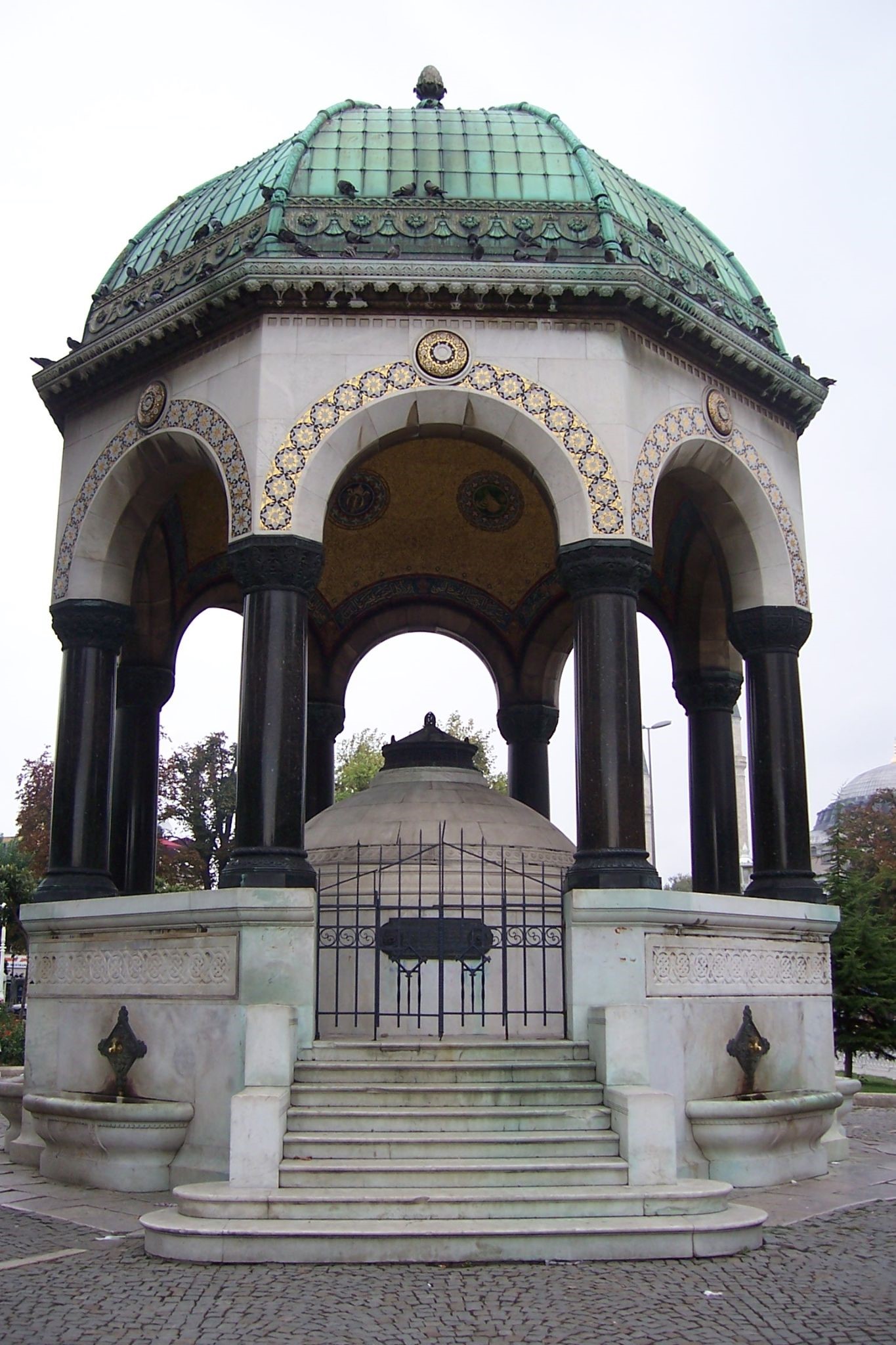
The German fountain was built in the hippodrome square as a memory of the second anniversary of German Emperor Wilhelm II's visit to Istanbul in 1898. All parts of the fountain were prepared in Germany, then brought to Istanbul and assembled in Istanbul. It was built entirely in the Neo-Byzantine style, which is contrary to Turkish fountain architecture. It is octagonal in shape and a copper-clad dome sits on top of eight arches supported by eight green columns. Accessed by a marble staircase from the west, a corridor surrounds the marble chamber in the middle.